Jump to:
Our introductory course for commercial growers and community groups working with veg or seed. The course runs over two webinars; attendance at both sessions is mandatory to complete the course.
Completing this intro course gives growers access to our Year-Long Seed Production Training course.
The next Introduction to Seed Saving courses will run in 2026. Dates are published on our events page.

Applications are now closed for the 2026 training. Please get in touch to be added to our interest list for the next round of training in 2028.
Join us for our year-long seed production training for growers across the UK and Ireland. Hosted by the Gaia Foundation’s Seed Sovereignty Programme, this course will combine expert teaching with peer-to-peer knowledge exchange to build your skills as a seed grower.
The course is designed to give you a broad understanding of the practicalities of seed production, as well as the political context of Seed Sovereignty. The course will be delivered by means of presentations, webinars and site visits. Some sessions are delivered online, and some will be face-to-face within your region.
Participants should be commercial food producers or community growers looking to distribute seed more widely. We ask that you have a good understanding of crop cultivation. Some seed saving experience is beneficial, but not necessary. This course is not suitable for home growers. (Home growers can find fantastic resources on seed saving at a garden scale from the Heritage Seed Library and through the Vital Seeds seed saving course).
Taught material is delivered on the first Wednesday evening of each month between March and November, and in two-hour sessions between 6 pm and 7:30 pm. There is a short ‘break’ during the summer months, which enables the more practical elements of seed production to be taught on site. Online delivery will be using Zoom.
Prior learning and prerequisites: This course sits broadly at Level 3. It assumes the following pre-requisites:
If you are less confident about the above, we would welcome the opportunity to discuss your individual circumstances (see below for contact information).
Our regional coordinators are based around the UK. To read more about them see our Who We Are page. Our ‘regions’ include Scotland, Northern England (north of Birmingham), Southern England (south of Birmingham), and Wales.
All applicants are required to fill out the application form. Eligible applicants will subsequently receive details regarding ticket purchasing information. Please email your regional coordinator with any questions regarding the application form.
Places are available for £200/ €200, with half-price subsidised and bursary tickets available.
Applications are now closed for the 2026 training. Please get in touch to be added to our interest list for the next round of training in 2028.
We ask you to commit to attending all the sessions throughout the year. You will need to grow two seed crops at the same time as taking part in the training and complete a portfolio in your own time.
| Session number and month | Provisional dates | Online (O) or in person (IP)? | Session title |
| 1) late February | tbc | IP | Meet your regional co-ordinator and cohort |
| 2) March | 4th March 2026 | O | Seed politics and sovereignty |
| 3) April | 1st April 2026 | O | Botanical basics for seed |
| 4) May | 6th May 2026 | O | Pests, diseases and disorders |
| 5) June | tbc | IP | Site visit: seed production |
| 6) July | 1st July 2026 | O | Genetics and plant breeding |
| 7) July | tbc | IP | Site visit: selection |
| 8) September | 2nd September 2026 | O | Contemporary Seed issues (gene editing, etc.) |
| 9) September | tbc | IP | Site visit: processing, testing and storing |
| 10) a & b October | 7th October 2026 | O | Seed legislation |
| 11) November | 4th November 2026 | O | Commercial and community seed |
| 12) November | tbc | IP | Seed Journal presentation & next steps |
Assessment is by means of a Seed Journal presentation and a minimum of 80% attendance. Your regional coordinator may also ask you to complete small tasks to consolidate your learning. This is a non-accredited, non-certificated course delivered at Level 3 (A-level equivalent), requiring approximately 45 guided learning hours and an additional 45 hours of self-directed study to complete the journal/additional learning. Completion of this course gives growers access to our Advanced Learning Opportunities, such as the Crowdbreeding project and Trials.

We are excited to launch our pilot training in Grain Seed Production. Click here to apply by 1 July 2026.
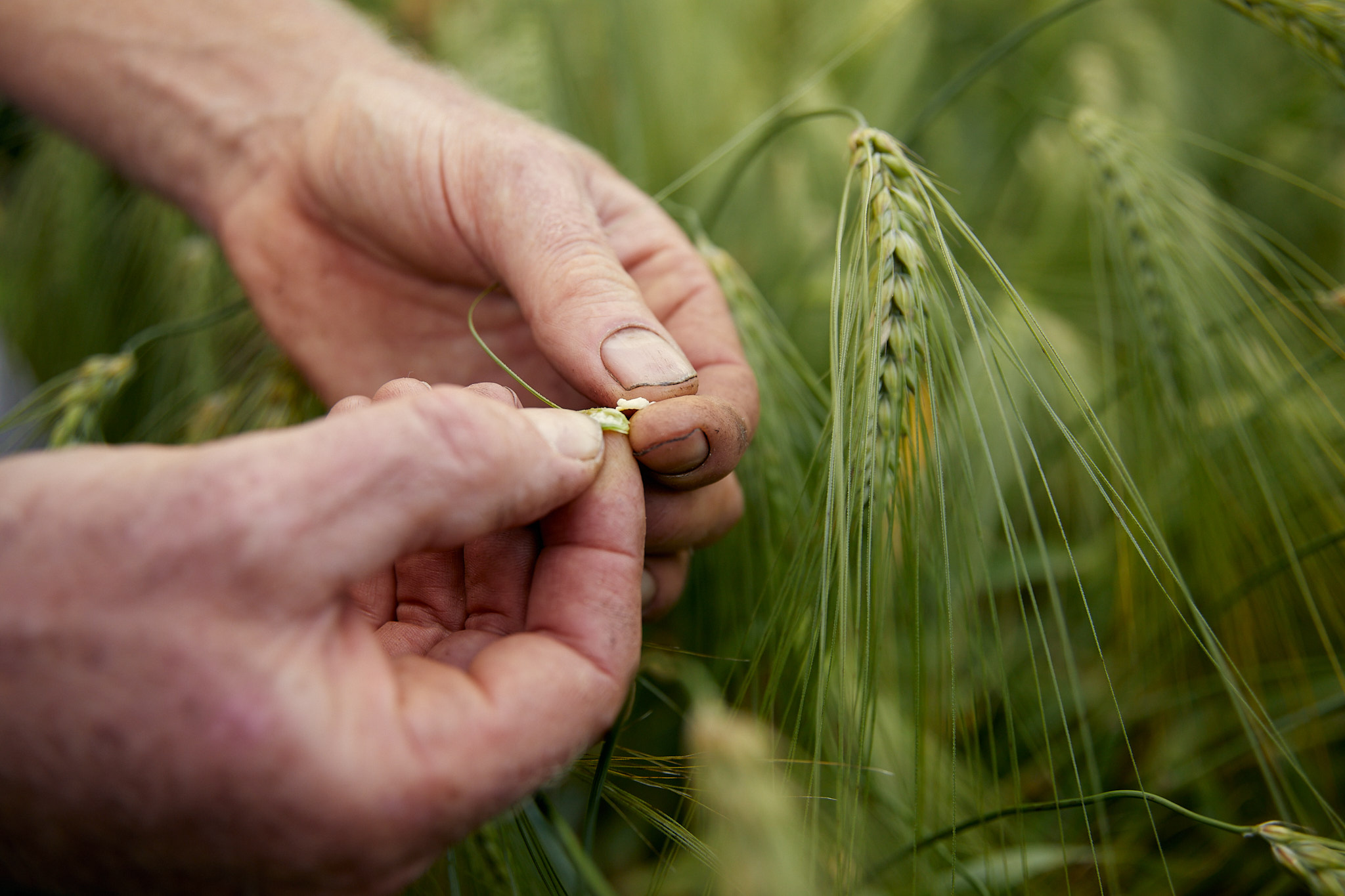
This newly launched course is designed to give participants the skills and confidence to take rare grains from seed into wider production, while gaining a deeper understanding of the politics of grain sovereignty in the UK.
If you are a grower, farmer, baker and/or grain enthusiast wanting to grow diverse grains on a small to medium scale, we would love to hear from you. We will focus on the skills and knowledge needed to grow rare grains for seed.
Online evening sessions will run from September 2026 to September 2027. Initially, these will be held fortnightly – the second and fourth Monday of the month during sowing season – moving to monthly from November onwards.
Sessions will cover a range of related topics and will be taught by a variety of practitioners in the UK diverse grains movement, including Robyn Minogue (South West Grain Network), Chris Maughan (Centre for Agroecology, Water and Resilience), Lisa Housten (Lauriston Farm) and Fred Price (Gothelney Farm).
In addition to online learning, participants will grow three small-scale grain seed crops* as part of the course. These crops will be grown for learning purposes, with participants recording their experience through a seed journal.
*We will grow two ‘heritage’ / ‘diverse’ wheat crops and one modern-bred wheat. Each crop will be grown in 10m x 1m strips. The suggested sowing times for the selected crops is September 2026, so participants should have an idea of where they will sow before they apply and should prepare the area ahead of the first session if their application is accepted.
There will also be an opportunity to take part in a study trip in summer 2027, looking at grain seed production in the fields. Participants will be responsible for their own travel arrangements.
Online sessions will take place from 18:00 – 19:30 on Monday evenings on the following dates:
Attendance at a minimum of 80% of online sessions is required to pass the course.
Additional in-person visits will be decided with your cohort and coordinator. There will also be an opportunity to take part in a study trip in summer 2027.
Before you apply, please check that you are aware of and can satisfy the following:
*This is a pilot, and our vision of who the trainees are isn’t completely formed. We welcome a diversity of applicants and applications, even if you are unsure you meet the prerequisites completely. If you feel that these requirements are currently out of reach, we would still like to support you in your learning journey. Please contact seedsovereignty@gaianet.org to discuss alternative options.
For the 2026/7 pilot, we can accept 20 participants onto the course. To take part, please fill out this online form.
Please note that completion of this application form does not constitute an offer of a place. All applications will be reviewed by the Seed Sovereignty team, who may wish to contact you for further information. The application deadline to apply for this pilot training programme is 1 July. You can expect to hear if your application is successful by 1 August.
Places on the 2026/7 pilot course are available for £200, with half-price subsidised tickets (£100) and full bursaries offered to those who may find these fees a barrier to their attendance. Course fees contribute towards session delivery, speaker remuneration, and the strengthening of this training and the wider grain sovereignty movement.
Successful applicants will receive details with ticket purchasing information by 1 August 2026.
A free, pre-recorded webinar series funded by Farming the Future, made in collaboration with the Seed Sovereignty Programme, CSA Network UK, and the Organic Growers Alliance, featuring speakers and growers from the wider network.
SeedTV is a webinar series hosted by The Gaia Foundation’s Seed Sovereignty Programme for the seed network in the UK and Ireland. Topics range from medicinal seeds to seed garlic, seed legislation changes to crowd breeding, but have one thing in common: seeds!
Join us (roughly) quarterly to delve deep into the rich, regenerative, radical world of seed as we explore topics that have the most interest and impact for our networks. Find upcoming SeedTV webinars on our events page.
In 2023, The Gaia Foundation’s Seed Sovereignty Programme launched a focus group to aid the creation and support of seed hubs throughout the UK and Ireland. We are delighted to share the recordings of the focus group’s sessions publicly.
Our aim through this focus group was to highlight some of the key challenges to be aware of, the most important decisions that arise, and the skillsets groups require to succeed. The sessions cover everything from organisational structures to processing seeds and marketing seed hubs.

The Community Seed Forum (CSF) is a bi-monthly, peer-to-peer learning space for new and experienced community seed projects (libraries, networks, circles, etc.) to exchange ideas, challenges and potential solutions about how these projects run.
Graduates of our Year-Long Seed Production Training gain access to our Continued Learning Opportunities, which include taking part in our UK & Ireland Seed Trials and our Crowdbreeding project, alongside other events and courses. In recent years, growers have taken part in a variety of trials, including blight-resistant tomato breeding in collaboration with renowned tomato breeder Simon Crawford, biennial trials with leek and parsley seeds, and dwarf French bean trials.

Learn more about Seed Sovereignty and the work our team are doing in the UK & Ireland:

One hundred years ago, not a single seed was owned. Today, seeds are one of the most controlled commodities in the world. Discover the importance of seed sovereignty.

Growing, sharing, and sowing agroecologically grown, open-pollinated seed for food justice, community connection, and biodiversity. Welcome to the world of seed saving.

The Seed Sovereignty Programme
Explore how our team are supporting a biodiverse, resilient seed system & small-scale seed production across the UK & Ireland.
